Last updated 2026-08-18
TL;DR
Dump trailer rental in Arkansas costs $150 to $250 per day for a standard 14-foot trailer, or $550 to $900 per week. Bigger goosenecks push toward $450 a day. Renting trailers out for hire requires Arkansas intrastate motor carrier registration through ArDOT and commercial insurance. No CDL is needed to tow most dump trailers under a 26,000 lb combined GVWR.
How much does dump trailer rental cost in Arkansas?
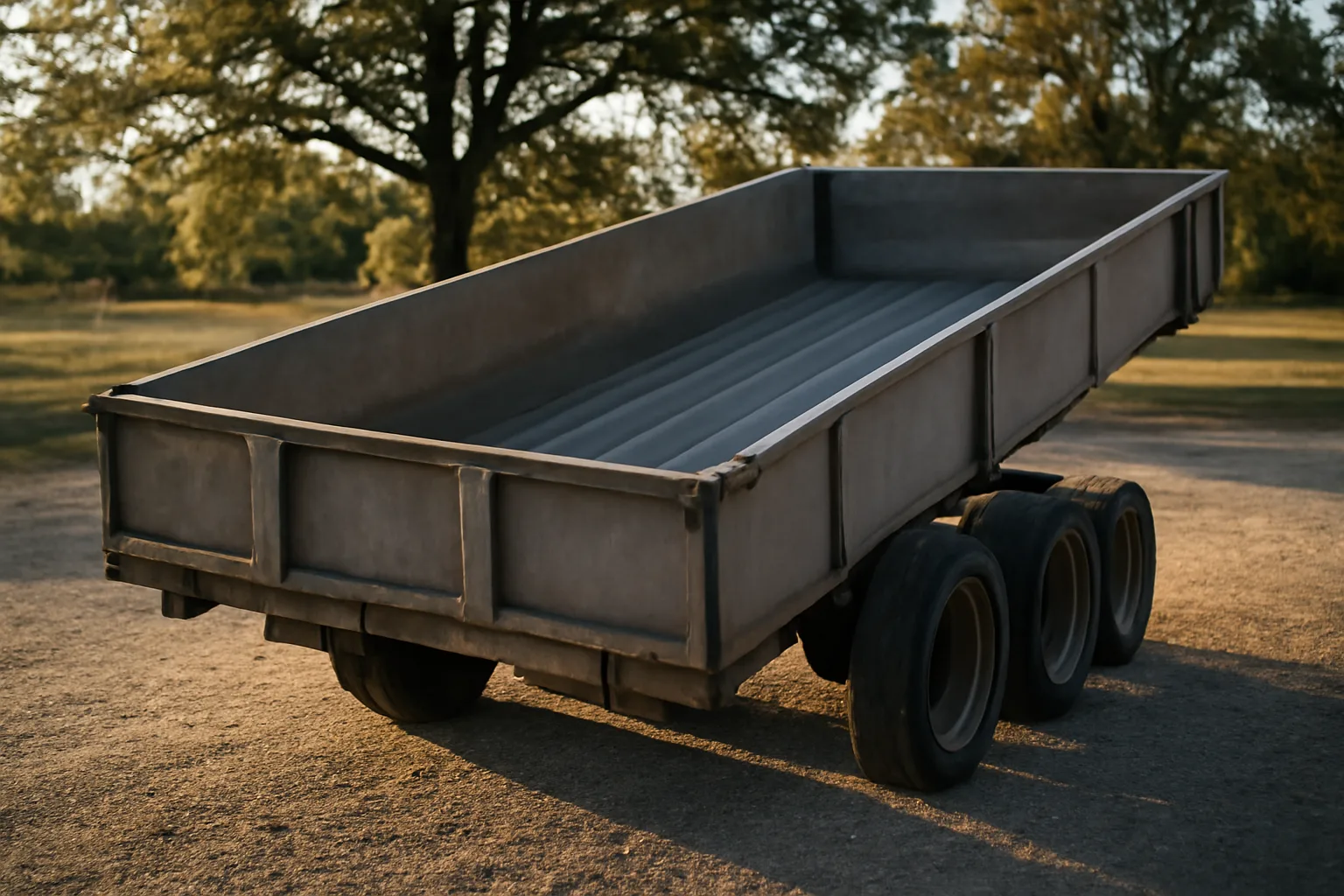
A standard 14-foot dump trailer (10,000 to 14,000 lb GVWR) rents for $150 to $250 per day at most Arkansas rental yards and equipment dealers. Larger 16-foot and 20-foot trailers in the 14,000 to 20,000 lb GVWR range run $225 to $450 per day. Weekly rates knock 30 to 40 percent off the daily figure, so a trailer that goes for $200 a day usually lands around $750 to $900 for the week. [1]
Those numbers move around. Rates in Little Rock and Fayetteville sit at the higher end because construction and landscaping demand runs heavier there. Rural yards in the Delta or the Ozarks often come in $30 to $60 per day cheaper, mostly a function of lower overhead and thinner competition. Call three yards before you book. The spread is real.
Most shops charge a mileage overage once you take the trailer past a set radius, usually 50 to 100 miles from pickup. Overage runs $0.50 to $1.50 per mile. That bites on a Little Rock to Fort Smith haul. Ask about the mileage cap before you sign.
Deposits are almost always required. Budget $200 to $500 on top of the rental rate, held on a credit card. Some yards waive it for commercial accounts, but building one takes time.
Here is a size-and-rate comparison based on typical Arkansas market pricing:
| Trailer size | Capacity (GVWR) | Daily rate | Weekly rate |
|---|---|---|---|
| 10-foot single axle | 7,000 to 10,000 lb | $120, $175 | $450, $650 |
| 14-foot tandem axle | 10,000 to 14,000 lb | $150, $250 | $550, $900 |
| 16-foot tandem axle | 14,000 to 16,000 lb | $200, $320 | $700, $1,100 |
| 20-foot gooseneck | 16,000 to 20,000 lb | $275, $450 | $900, $1,400 |
These are market ranges, not guaranteed quotes. Confirm current pricing directly with the yard.
What factors push Arkansas dump trailer rental rates up or down?
Size is the single biggest driver. A 10-foot single-axle trailer costs far less to own, maintain, and insure than a 20-foot gooseneck, and yards pass that difference straight to you.
Season matters a lot in Arkansas. Spring landscaping (March through May) and fall cleanup (September through October) tighten supply in the larger markets. Rates can climb 15 to 25 percent during peak weeks purely from demand. Schedule a non-urgent job for January or February and you will almost always pay less.
Duration flips the math. Most shops give their best rate at the weekly level. A month-long rental often negotiates down to 2.5 or 3 times the weekly rate instead of four. Ask directly. Most yards have flex on long-term rentals that never shows up on the posted sheet.
Insurance adds to your out-of-pocket cost if you do not already carry coverage. Some shops sell a damage waiver for $25 to $60 per day. That is almost always overpriced next to adding a trailer endorsement to a commercial auto policy for the rental window. Check with your insurer first. [2]
Delivery and pickup fees get overlooked. Shops that deliver charge $75 to $200 depending on distance. No capable tow vehicle? Delivery might be worth it. For most jobs, haul it yourself and keep the money.
Do you need a license to rent a dump trailer in Arkansas?
If you are a customer renting for personal use, it depends entirely on what you tow it with. Arkansas follows the federal CDL thresholds: you need a Class A CDL only if the combined GVWR of tow vehicle plus trailer exceeds 26,000 lbs AND the trailer alone exceeds 10,001 lbs GVWR. [3] Most residential rentals stay under that line. A 14,000-lb trailer behind a half-ton or three-quarter-ton pickup puts the combination around 20,000 to 22,000 lbs, well below the CDL cutoff.
Starting a business to rent trailers to others is a different picture. Arkansas requires for-hire motor carriers operating inside the state to register with the Arkansas Department of Transportation (ArDOT). Intrastate for-hire carriers get an Arkansas Intrastate Operating Authority registration through ArDOT's motor carrier division. [4] Fees change periodically. Confirm current rates with ArDOT before you budget.
For-hire operations also register vehicles under the International Registration Plan (IRP) if they cross state lines, and comply with IFTA fuel tax reporting if the vehicle exceeds 26,000 lbs or has three or more axles. [5] A one-trailer intrastate business may trigger neither if all equipment stays under those thresholds and in-state.
Arkansas has no standalone rental license aimed at dump trailers. What you actually assemble is business registration, motor carrier registration, and insurance compliance. Those three together are your legal footing.
One more thing. Trailers titled in Arkansas register through the Department of Finance and Administration, which handles vehicle titling. [6] Commercial trailers get a separate plate and registration cycle from personal ones.
What insurance does Arkansas require for dump trailer rental operations?
Arkansas intrastate for-hire carriers must carry the minimum public liability and property damage coverage set by ArDOT. The federal minimum for non-hazardous freight carriers under FMCSA rules is $750,000 combined single limit for vehicles over 10,001 lbs GVWR. [7] Arkansas intrastate figures can differ, so confirm the exact number with ArDOT's motor carrier division before you buy a policy.
For a small rental business, the practical coverage you want runs higher than the paper minimum. Most lenders and yard operators carry $1 million in commercial general liability plus a commercial auto policy covering the trailers for non-owned-auto use by renters. When a renter damages your trailer or hits someone else's property, the gap between a bare-minimum policy and a well-built one gets expensive fast.
The paper path runs through a certificate of insurance filed with ArDOT in the correct form. Confirm which form ArDOT currently accepts before your broker files anything, because state filing requirements shift and the wrong form bounces the application.
Personal auto policies almost never cover trailers used in a commercial rental operation. That distinction matters. Buy a trailer, rent it out twice, and have something go wrong, and your personal insurer has clean grounds to deny the claim.
Early in your research on insurance structure? DumpTrailerPath's Peer-Haul Insurance Kit ($129, one-time) walks the paper path for getting properly covered without overpaying, including exactly what to ask a commercial lines broker. It is at /start.
How long does a dump trailer rental take in Arkansas?
For a personal rental, it is fast. Most Arkansas yards have you out the door in 30 to 60 minutes once you show up with a valid driver's license, a credit card for the deposit, and a tow vehicle set up with the right hitch. Reserve online or by phone a day ahead and pickup drops to 15 to 20 minutes. Plan around spring and fall busy weeks, because popular sizes book out several days early.
A commercial rental business takes longer to stand up. Business entity registration through the Arkansas Secretary of State runs a few days for online filing to two or three weeks by paper. [8] Motor carrier registration with ArDOT stacks on top. Insurance underwriting for a new commercial operation usually takes three to seven business days to bind a policy and file the certificate. A brand-new Arkansas rental operation can be legally running in four to six weeks if you keep every step moving. Delays show up when paperwork comes back with errors or ArDOT asks for more documentation.
Trailer acquisition is usually the longest wild card. New trailers back-order 8 to 16 weeks from the factory. Used inventory at Arkansas dealers and auctions moves fast, so when the right unit shows up, buy it. Build that reality into your launch timeline.
How does Arkansas compare to neighboring states on dump trailer rental costs?
Arkansas sits in the mid-to-lower range for the South. Daily rates in Tennessee markets like Memphis run higher, $175 to $350 for comparable sizes, driven by stronger urban demand. Missouri rates land close to Arkansas. Oklahoma and Louisiana hug the same band.
For broader context, compare pricing structures in dump trailer rental cost in Alabama, dump trailer rental cost in Georgia, and dump trailer rental cost in Florida. The Southeast stays cheaper than the West Coast by a real margin. California daily rates for equivalent trailers often run $350 to $600. [9]
Arkansas also carries lower fuel costs than coastal states, which counts once you fold towing into the total. A 20-foot gooseneck loaded with debris or fill pulls fuel economy down to 8 to 11 mpg for most diesel pickups, so a 100-mile haul adds real money beyond the rental invoice.
What paperwork do you need to start renting dump trailers in Arkansas?
Start with your business entity. An LLC is the common structure for small equipment rental operations here. File Articles of Organization through the Arkansas Secretary of State. [8] The domestic LLC filing fee is $45 online or $50 by mail as of early 2025; confirm current fees at the SOS site, since these change.
Next, an EIN from the IRS. Free and instant online. You need it to open a business bank account and to handle employment taxes if you ever hire. [10]
Motor carrier registration with ArDOT comes next if you run trailers for hire. ArDOT's Motor Carrier Services division handles intrastate authority applications. It wants your entity documentation, proof of insurance in the correct filing form, and a description of operations.
For trailer titling, go to the Arkansas Department of Finance and Administration, Revenue Division. Commercial trailers get titled and registered there. [6] Bring a manufacturer's statement of origin (MSO) for a new trailer or the prior title for a used one, plus the title and registration fees.
If your combined tow vehicle and trailer top 26,000 lbs and you cross state lines, add IRP registration and IFTA licensing. Both run through ArDOT. [5]
The full stack looks like this:
| Step | Agency | Approximate cost | Where to apply |
|---|---|---|---|
| LLC formation | AR Secretary of State | $45, $50 | sos.arkansas.gov |
| EIN | IRS | Free | irs.gov |
| Intrastate motor carrier authority | ArDOT Motor Carrier | Confirm with ArDOT | ardot.gov |
| Commercial insurance filing | ArDOT (via insurer) | Varies | Through your broker |
| Trailer title and registration | AR DFA Revenue Division | Confirm with DFA | dfa.arkansas.gov |
| IRP/IFTA (if applicable) | ArDOT | Confirm with ArDOT | ardot.gov |
Verify every fee and processing time directly with each agency before you budget against it.
What size dump trailer makes sense for most Arkansas rental customers?
The 14-foot tandem-axle trailer is the workhorse for most residential and light commercial jobs in Arkansas: yard cleanup, demolition debris, gravel or mulch hauling, small construction spoils. It handles roughly 5 to 7 cubic yards of loose debris, which covers most single-day residential work.
The 16-foot tandem is the next step up. It makes sense for landscaping contractors, pool crews, and roofing tearoffs where volume runs higher. If you run a fleet, stocking at least two sizes covers the widest customer range without buying specialty equipment that sits idle.
A gooseneck dump trailer (16 to 20 feet) is overkill for homeowner rentals but exactly what excavation and land-clearing crews want. If your market is mostly residential, one gooseneck plus two standard bumper-pull tandems is a common starting fleet.
On the customer side: hauling gravel or dirt for a small landscaping project? A single-axle 10-foot trailer saves money and is far easier to back into a tight residential lot. Do not pay for capacity you will not use.
See how fleet decisions and costs compare in dump trailer rental cost in Colorado and dump trailer rental cost in Illinois if you are weighing a multi-state operation.
What are the ongoing costs for a dump trailer rental business in Arkansas?
Insurance is the biggest recurring fixed cost after any equipment financing. A commercial auto policy covering two or three trailers for non-owned use by renters typically runs $2,500 to $5,000 per year for a small fleet, depending on trailer values, coverage limits, and loss history. Commercial general liability adds another $800 to $1,500 per year for a small operation. Rough ranges. Get actual quotes from a commercial lines broker licensed in Arkansas.
Maintenance is real money. Bearings, brake adjustments, tire replacements, hydraulic cylinder service. A reasonable reserve is $800 to $1,500 per trailer per year for a fleet that rents regularly. Renters are hard on equipment.
Storage gets underestimated. You need a yard, a lot, or a secure facility. If you do not own land, commercial storage or a yard lease in a market like Little Rock runs $300 to $800 per month depending on space.
Marketing costs stay low if you list on equipment rental platforms and keep a basic Google Business Profile, both free. Paid ads on Google Local Services or Facebook are optional but can speed up early bookings.
Arkansas adds no gross receipts tax specific to equipment rental beyond the standard state sales tax, which is 6.5 percent at the state level with local rates adding 0 to 6 percent on top. [11] You collect the sales tax on rental receipts and remit it to the Arkansas Department of Finance and Administration. Verify your product code and tax treatment with a CPA or the DFA directly.
What should you check before renting a dump trailer in Arkansas?
Before you hook up and drive off, check the hydraulic lift. Ask the yard to demonstrate the dump function under load. A cylinder that stutters or leaks on a light load will fail under a full bed of wet concrete debris on the job site.
Check all four tires on a tandem-axle trailer, more than the ones you can see. The inner dual tires get skipped in quick pre-rental inspections and often turn up underinflated or worn.
Inspect the floor. Steel floors rust out from the inside faster than they look bad from the outside. Probe the corners and the floor seams with your foot. A soft spot means the floor is compromised and could give out under a full load.
Verify the ball or pintle hitch size before you leave home. Most bumper-pull dump trailers use a 2-5/16 inch ball. A 2-inch ball will look seated but is not safe to tow. Confirm the coupler with the yard.
Make sure your tow vehicle's brake controller is wired and working. Arkansas law requires brakes on every axle of a trailer with a GVWR over 3,000 lbs. [12] Running a 14,000-lb trailer with dead electric brakes is illegal and genuinely dangerous.
Document the trailer condition with photos and video at pickup and return. Damage disputes are the most common complaint in equipment rental, and they almost always go to whoever has better documentation.
Where can you rent a dump trailer in Arkansas?
The easiest starting points are the national chains with Arkansas locations. United Rentals and Sunbelt Rentals both operate in Little Rock, Fayetteville, and Fort Smith and carry dump trailers. Their online portals let you check availability and reserve ahead. Chain pricing tends to run a little higher than independent yards, but consistency and availability are better.
Independent yards, often bolted onto a landscape supply or building materials dealer, frequently beat the chains on day rates and bend more on longer rentals. A local operator will also give you the honest conversation about what size you actually need, which is worth something.
Peer-to-peer platforms like Neighbor and Fat Llama sometimes list dump trailers in Arkansas markets, though inventory is thin next to bigger metro areas elsewhere. Check them, but do not lean on them as your primary source.
For comparison shopping, see how regional markets differ in dump trailer rental cost in Alabama and dump trailer rental cost in Georgia. Sizing up a rental business? dump trailer rental cost in California and dump trailer rental cost in Arizona give you a useful contrast on how competitive different state markets are.
DumpTrailerPath's resource library at /start covers how to build the insurance paper trail for a new Arkansas operation without guessing at what your insurer needs to file with ArDOT.
Frequently asked questions
How much does dump trailer rental cost in Arkansas per day?
A standard 14-foot tandem-axle dump trailer rents for $150 to $250 per day at most Arkansas yards. Smaller single-axle trailers run $120 to $175 per day. Large 20-foot goosenecks can reach $275 to $450 per day. Rates vary by location, season, and individual shop. Little Rock and Fayetteville tend to price at the higher end of these ranges.
Do you need a CDL to rent a dump trailer in Arkansas?
No CDL is required for most residential dump trailer rentals in Arkansas. You only need one if the combined GVWR of tow vehicle plus trailer exceeds 26,000 lbs and the trailer alone exceeds 10,001 lbs. Most dump trailers pulled by a pickup stay well under that threshold. If you are unsure about your combination, check the GVWR labels on both vehicles.
Do you need a license to rent dump trailers out to others in Arkansas?
Yes. Operating as a for-hire motor carrier in Arkansas requires intrastate operating authority from the Arkansas Department of Transportation (ArDOT). You also need your business registered, commercial insurance filed in the correct form with ArDOT, and your trailers titled and registered through the Arkansas Department of Finance and Administration. There is no separate dump trailer rental license; it is a combination of motor carrier and business compliance steps.
How long does it take to set up a dump trailer rental business in Arkansas?
Budget four to six weeks if you move efficiently. LLC formation takes a few days to two weeks depending on whether you file online or by mail. Motor carrier registration with ArDOT and insurance underwriting add another one to three weeks. Trailer acquisition is often the longest variable: new trailers can back-order 8 to 16 weeks. Used units available locally can shorten that timeline a lot.
What insurance is required to rent dump trailers in Arkansas?
For-hire motor carriers in Arkansas must carry minimum public liability and property damage coverage per ArDOT requirements. Federal FMCSA rules set a $750,000 combined single limit for non-hazardous freight vehicles over 10,001 lbs GVWR. Arkansas intrastate minimums may differ, so confirm the exact figure with ArDOT. Most operators carry at least $1 million in commercial general liability on top of commercial auto coverage for the trailers.
What is the cheapest dump trailer rental option in Arkansas?
A small single-axle trailer (7,000 to 10,000 lb GVWR) at an independent rural yard is usually cheapest, often $120 to $150 per day. Renting during the off-season (January and February) also saves 15 to 25 percent versus spring peak rates. Peer-to-peer platforms occasionally list trailers cheaper than commercial yards, but Arkansas availability is limited.
Does Arkansas charge sales tax on dump trailer rentals?
Yes. The Arkansas state sales tax rate is 6.5 percent, and local jurisdictions add 0 to 6 percent on top. Equipment rental receipts are subject to sales tax, which the rental operator collects and remits to the Arkansas Department of Finance and Administration. If you run a rental business, confirm your specific tax code classification with the DFA or a licensed Arkansas CPA before setting your pricing.
What size dump trailer do I need for a residential cleanout in Arkansas?
A 14-foot tandem-axle dump trailer handles 5 to 7 cubic yards of debris, which covers most single-day residential cleanouts including furniture, yard waste, or light demolition material. If you are hauling heavy materials like concrete or gravel, the weight limit matters more than volume: a 14,000-lb GVWR trailer can carry roughly 4 to 5 tons, enough for most residential jobs.
Can I rent a dump trailer in Arkansas without a commercial account?
Yes. Most Arkansas yards rent to individuals without a commercial account. You need a valid driver's license, a credit card for the deposit ($200 to $500 is typical), and a tow vehicle with the right hitch setup. A commercial account can get you better rates and skip the deposit, but it takes time to establish and requires a credit application with the yard.
What is the weekly rate for a dump trailer in Arkansas?
Weekly rates in Arkansas typically run $550 to $1,200 depending on size. A 14-foot tandem-axle trailer runs $550 to $900 per week. A 20-foot gooseneck can reach $900 to $1,400 per week. Weekly rates come out 30 to 40 percent cheaper per day than the daily rate, so if you need a trailer for more than four or five days, the weekly rate almost always wins.
Are there mileage limits on dump trailer rentals in Arkansas?
Many Arkansas yards impose a mileage cap, typically 50 to 100 miles from the pickup location. Exceeding it triggers overage fees of $0.50 to $1.50 per mile. If you plan to haul across the state, say from Little Rock to Fort Smith or up to Bentonville, confirm the mileage policy and calculate the total cost before booking.
How do Arkansas dump trailer rental rates compare to neighboring states?
Arkansas sits in the mid-to-lower range for the South. Daily rates for comparable 14-foot trailers run slightly higher in Tennessee markets and about the same in Missouri and Oklahoma. Florida and Georgia rates land close to Arkansas but skew higher in major metro areas. California and Arizona rates run substantially higher, often $350 to $600 per day for equivalent equipment.
Do rental yards in Arkansas require proof of tow vehicle insurance?
Some do, some do not, but it is increasingly common. Commercial yards and chain locations are more likely to ask for proof of insurance on your tow vehicle before releasing the trailer. Even when it is not required, your personal auto liability coverage generally extends to a rented trailer while it is attached, but confirm that with your insurer before pickup to avoid surprises.
What trailer braking rules apply in Arkansas?
Arkansas law requires brakes on every wheel of a trailer with a gross weight over 3,000 lbs when loaded. Most dump trailers clear that threshold. Electric trailer brakes need a functioning brake controller in the tow vehicle. Confirm your controller is properly calibrated before towing. Operating a heavy trailer without working brakes is illegal in Arkansas and a serious safety hazard on hilly terrain.
Sources
- American Rental Association, Equipment Rental Industry Fact Sheet 2023: Equipment rental rate ranges and weekly vs daily rate discount patterns for trailers in regional U.S. markets
- Insurance Information Institute, Auto Insurance Basics: Personal auto policies typically exclude commercial rental operations and business use of trailers
- Federal Motor Carrier Safety Administration, CDL Requirements: CDL Class A required when combined vehicle GVWR exceeds 26,000 lbs and towed unit exceeds 10,001 lbs
- Arkansas Department of Finance and Administration, Motor Vehicle Titling and Registration: Arkansas trailers are titled and registered through the DFA Revenue Division; commercial trailers use a separate plate and cycle
- Federal Motor Carrier Safety Administration, Minimum Levels of Financial Responsibility, 49 CFR Part 387: $750,000 combined single limit minimum insurance for for-hire carriers transporting non-hazardous freight in vehicles over 10,001 lbs GVWR
- Arkansas Secretary of State, Business and Commercial Services: LLC Articles of Organization filed with the Arkansas Secretary of State; online filing is faster than paper
- California Air Resources Board, Portable Equipment Registration Program: California equipment rental market reference for regional rate comparison context
- IRS, Apply for an Employer Identification Number (EIN) Online: EIN is free and available instantly online through the IRS for new business entities
- Arkansas Department of Finance and Administration, Sales and Use Tax: Arkansas state sales tax rate is 6.5 percent; local jurisdictions add additional rates; equipment rental receipts are taxable
- Arkansas Code Annotated, Title 27 Transportation, Section 27-37-501, Brakes Required: Arkansas law requires brakes on every wheel of a trailer with a gross weight exceeding 3,000 lbs