Last updated 2026-08-18
TL;DR
Arkansas has no single "dump trailer rental license." You need an LLC or sole-proprietor registration with the Secretary of State, a sales tax permit from the Department of Finance and Administration, and compliance with IFTA and federal DOT rules if the tow vehicle crosses gross weight thresholds. Expect startup filing costs under $200, plus insurance. Confirm current fees with the relevant state office before filing.
Do you need a license for dump trailer rental in Arkansas?
No Arkansas agency issues a standalone "dump trailer rental license." What you actually need is a stack of registrations that together let you rent equipment legally, collect money, and put your rigs on public roads.
The short list: a business entity registration (or a DBA if you run as a sole proprietor), a sales tax permit from the Arkansas Department of Finance and Administration, and, if your tow vehicle or a customer's combined rig exceeds 26,001 pounds gross vehicle weight, compliance with federal DOT registration rules. If you operate across state lines, the International Fuel Tax Agreement (IFTA) applies to the towing vehicle, not the trailer itself [1].
Arkansas does not license equipment rental companies the way some states license contractors or auto dealers. The state cares about tax collection and, for heavy vehicles, highway safety. That's good news for new operators. You can be legally open within a few business days if your paperwork is ready.
Here's what people miss. If you rent to contractors who haul debris or demolition waste, check whether those customers need a solid waste hauler permit under Arkansas environmental regulations. That permit falls on the renter, not you. Knowing it exists protects you when a customer asks.
What business registrations does Arkansas require?
Start with your business entity. An LLC is the standard choice because it separates your personal assets from rental liability. Arkansas LLC formation costs $45 as of the most recent published fee schedule from the Secretary of State [3]. You file Articles of Organization online through the Arkansas Secretary of State's business portal. Sole proprietors operating under a trade name file a Fictitious Name Certificate in the county where the business sits, which goes through the county circuit clerk, not the state, and usually costs under $25.
After entity formation, register for your Arkansas sales tax permit through the Department of Finance and Administration. Arkansas taxes rentals of tangible personal property, and dump trailer rentals fall squarely inside that [4]. The permit itself is free. You collect sales tax from customers at the point of rental, file returns on the schedule the DFA assigns based on expected volume (monthly, quarterly, or annually), and remit the collected tax. The Arkansas state sales tax rate is 6.5%, with local taxes stacked on top depending on the county or city where the rental happens. Confirm the exact combined rate for your location with the DFA or a local tax advisor before you quote customers.
Form an LLC and you also need a registered agent with an Arkansas physical address. You can serve as your own agent, or hire a service for roughly $50 to $150 per year.
Check with your city or county about a local business license. Little Rock, Fayetteville, Fort Smith, and most incorporated municipalities require a general business license that runs anywhere from $25 to $150 per year. Unincorporated areas typically have no such requirement. Call your city clerk to confirm.
How do federal DOT and IFTA rules apply to dump trailer rental in Arkansas?
This is where operators get surprised. The trailer never gets a DOT number. The towing vehicle does, under certain conditions.
Federal motor carrier regulations require a USDOT number if a vehicle operates in interstate commerce and has a gross vehicle weight rating or gross combination weight rating over 10,001 pounds [5]. A pickup pulling a loaded 14-foot dump trailer clears that threshold easily. If you or your employees ever tow your rental fleet between states (repositioning units, delivering to a job across a state line), the tow vehicle needs a USDOT number.
If your operation is purely intrastate (you rent in Arkansas to customers who use the trailers only in Arkansas), federal carrier rules reach less far, but Arkansas mirrors many of the same commercial vehicle standards. Vehicles pulling trailers that push the combined weight over 26,001 pounds are subject to Arkansas commercial vehicle inspection rules and weight limits [6].
IFTA applies to motor vehicles (not trailers) with two axles and a GVW over 26,000 pounds, or three or more axles regardless of weight, that travel in two or more IFTA jurisdictions. If a customer borrows your trailer and pulls it across state lines with their own truck, IFTA is their responsibility for that tow vehicle. If you deliver trailers with your own truck across state lines, IFTA becomes yours. Register for IFTA through the Arkansas Department of Finance and Administration Motor Fuel Tax section [1].
A small, local-only operation may never trigger any of these thresholds. But if you're building a multi-unit fleet you'll haul around yourself, price a USDOT registration into your startup budget. Registration is free. The compliance obligations that follow (driver logs, vehicle inspection records) are what cost time and money.
How much does dump trailer rental cost in Arkansas (startup and customer rates)?
There are two cost questions here: what it costs you to start legally, and what customers pay to rent.
On the startup side, the core paper costs are small. LLC filing is $45 with the Secretary of State [3]. The DFA sales tax permit is free [4]. A USDOT number is free through the FMCSA online portal [5]. Budget $50 to $150 for a registered agent if you use one, $25 to $150 for a local business license depending on your municipality, and some amount for liability insurance (see below). All in, most Arkansas dump trailer rental businesses spend under $500 getting legally established, not counting the equipment itself.
On the customer side, rental rates in Arkansas are set by local market conditions, not any state regulation. Rates across the region generally fall in these ranges by equipment type, though you should confirm with local competitors since no published survey tracks Arkansas specifically:
| Trailer size | Day rate (estimated range) | Weekend rate (estimated range) |
|---|---|---|
| 6x10 single-axle | $75 to $120 | $110 to $180 |
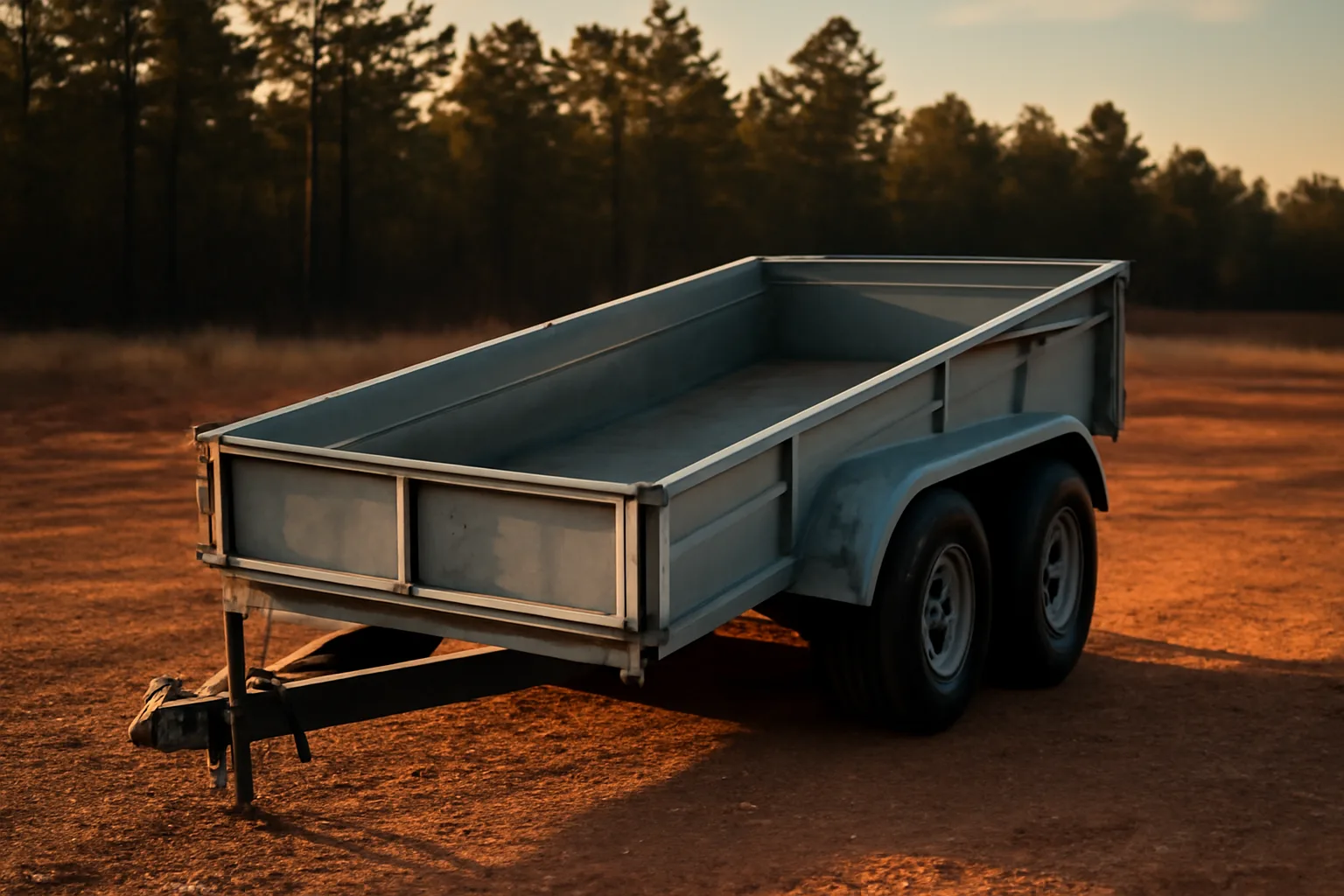
| 14-foot tandem-axle | $110 to $175 | $160 to $250 |
| 16-foot heavy-duty | $150 to $225 | $210 to $320 |
These ranges come from publicly posted rates on rental company websites and equipment marketplaces in Arkansas and the surrounding region as of 2025. They are not from a controlled study. Rates vary by metro (Fayetteville and Little Rock tend to run higher than rural markets), trailer condition, and included mileage.
Insurance is the cost that actually surprises new operators. A commercial inland marine policy covering a single dump trailer can run $400 to $1,200 per year depending on trailer value and your insurer. General liability coverage for a rental operation typically adds $600 to $1,500 per year for a small fleet. Get quotes from at least three carriers. Peer-to-peer and small-fleet operators sometimes use specialty products like the DumpTrailerPath Peer-Haul Insurance Kit ($129 one-time) to understand what coverage they actually need before they shop carriers, which helps avoid buying the wrong policy.
How long does the licensing process take in Arkansas?
Fast. Arkansas has no dedicated rental equipment license with a review board or approval queue, so there's nothing to wait in line for.
Arkansas LLC online filing typically processes in one to three business days through the Secretary of State's electronic system [3]. Paper filings take two to four weeks, so there's no reason to mail anything. The DFA sales tax permit issues within a few days of online application. A USDOT number through FMCSA's online system (if you need one) often issues the same day.
File everything online on day one and you can have every state-level registration in hand within a week. The longer delays come from waiting on insurance quotes and approval, opening a business bank account, and (if it applies) getting a commercial lease signed before your city business license issues.
Don't treat any of these timelines as guaranteed. Processing volumes, system outages, or application errors can slow things down. The Secretary of State and DFA are the two offices whose timelines matter most for your go-live date.
Do you need special insurance for dump trailer rental in Arkansas?
Arkansas sets no statutory insurance minimum specifically for equipment rental companies. That doesn't mean you can skip coverage. Any rental operation without insurance is one accident away from a judgment against your personal assets if you're a sole proprietor, or against your LLC if your coverage doesn't cover the size of the claim.
The two policies you actually need are a commercial inland marine policy (covers the trailers themselves against damage and theft while rented out or stored) and a general liability policy (covers bodily injury or property damage arising from the rental). Some carriers combine these into a business owner's policy for small operations.
If a customer's tow vehicle causes an accident while pulling your trailer, their auto liability is typically primary. Your rental agreement should require the renter to carry liability insurance and name you as an additional insured or loss payee where appropriate. This is a contract matter, not a state licensing matter, but it's where most rental operators get hurt financially.
Rent to commercial contractors regularly and those customers may want a certificate of insurance from you before they'll rent. That's an industry norm, not a legal requirement, but it shapes what policy limits you carry.
What paperwork do customers sign when renting a dump trailer in Arkansas?
The rental agreement is your most important document, and Arkansas has no state-mandated form for equipment rental. You write your own, or use an attorney-drafted template.
At minimum, your agreement should spell out the parties, the specific trailer (by VIN or serial number), the rental period, the rate and payment terms, security deposit policy, what conditions count as damage beyond normal wear, who carries liability insurance for what, and a clear statement that the renter is responsible for the load, its weight, and proper tie-down. Arkansas follows general common law contract rules, so a clear written agreement signed before the trailer leaves your lot is your primary legal protection.
Arkansas does not require you to be a licensed dealer to rent equipment, unlike some states that require a dealer license to rent motor vehicles. Trailers are not motor vehicles under Arkansas law. They are titled separately and need no dealer license to rent [6]. Confirm this reading with a local attorney before you scale, because the line between "trailer" and "vehicle" in licensing law can shift with trailer weight and registration class.
How do Arkansas trailer title and registration rules affect your rental fleet?
Every dump trailer in your fleet must be titled and registered in Arkansas if it will run on public roads. Trailers are titled through the Arkansas Department of Finance and Administration's Office of Motor Vehicle [9]. You pay a one-time title fee and an annual registration fee, and both amounts depend on the trailer's weight and classification. Confirm current fee amounts directly with the DFA Office of Motor Vehicle, since these figures update periodically.
For trailers over 10,000 pounds GVWR, registration follows a commercial trailer classification with higher fees. Trailers used purely on private property aren't required to be titled or registered, but that's rarely the case in a rental operation.
Verify that the trailer's VIN is recorded on the title and that you have clear chain of title before buying used units. A lien on a used trailer follows the trailer, not the seller. Pull a title history before any used purchase.
Some Arkansas counties assess personal property tax on business equipment, trailers included. Check with your county assessor's office each year to avoid a surprise tax bill. This varies by county and is not administered at the state level.
What are the weight and road rules that affect dump trailer rentals in Arkansas?
Arkansas sets maximum vehicle weight limits under Ark. Code Ann. Section 27-35-201 [6]. Single-axle vehicles are limited to 20,000 pounds. Tandem-axle limits depend on axle spacing. Combined gross weight on any single highway trip is capped at 80,000 pounds under standard permits, consistent with federal bridge formula rules.
The practical effect for your business: tell customers these limits in your rental agreement and on a posted notice at point of rental. If a customer overloads your trailer and gets cited by Arkansas State Police or a weigh station officer, the citation goes to the operator of the vehicle. But an overloaded trailer can also sustain frame damage that becomes a dispute with you over who pays.
Arkansas issues overweight permits through the Arkansas Department of Transportation (ARDOT) for loads that exceed standard limits [7]. These are the customer's responsibility to obtain, not yours, but knowing they exist lets you answer the question when a contractor asks about hauling something heavy.
For operations in or around Northwest Arkansas (Fayetteville, Springdale, Rogers, Bentonville), local infrastructure rules can be tighter on some roads. Check with ARDOT and local public works offices if your customers regularly work in those areas.
What is the complete Arkansas dump trailer rental startup checklist?
Here's the actual sequence most operators follow, in order:
1. Choose a business structure (LLC strongly recommended) and file with the Arkansas Secretary of State online. Pay the $45 filing fee [3]. 2. Get your EIN from the IRS (free, instant online at irs.gov) [8]. 3. Register for an Arkansas sales tax permit with the DFA (free) [4]. 4. Check your city or county for a local business license and file if required. 5. If you'll cross state lines with tow vehicles, register for a USDOT number at the FMCSA portal (free) [5]. 6. If it applies, register for IFTA with the DFA Motor Fuel Tax section [1]. 7. Title and register all trailers with the DFA Office of Motor Vehicle [9]. 8. Buy commercial inland marine insurance and general liability coverage. 9. Draft or have an attorney review your rental agreement template. 10. Open a business bank account (requires EIN and entity documents). 11. Set up your sales tax filing schedule as assigned by the DFA.
For operators who want to understand the insurance side before calling brokers, DumpTrailerPath's Peer-Haul Insurance Kit walks through what each coverage type actually does in equipment rental, which makes the broker conversation more productive.
Comparing how neighboring states handle this? Arkansas is simpler than most. See how the process works in Alabama, and California is worth comparing if your model spans borders.
Common mistakes Arkansas dump trailer rental operators make in year one
Not collecting sales tax from day one is the most common and most expensive mistake. The DFA can audit back multiple years and assess unpaid tax plus interest and penalties. Arkansas taxes tangible personal property rentals. That's your trailer. Set up tax collection in your rental software or invoicing system before you rent the first unit [4].
The second mistake is skipping the trailer title or leaving a trailer titled in a prior owner's name. If that trailer is in an accident, insurance disputes get far messier when the insured party isn't the legal owner on the title.
Third: underinsuring, or using a personal auto policy to cover a commercial trailer fleet. Personal auto policies almost universally exclude commercial rental activity. The claim gets denied. Inland marine coverage for rentable equipment is cheap relative to the trailer's value and the exposure.
Fourth: no written rental agreement. A handshake or a receipt is not a contract. When a customer returns a trailer with a bent frame and claims it was already that way, your signed agreement with a condition checklist and photos is your only evidence.
Fifth: not tracking which county or city the rental happens in for sales tax. Arkansas has hundreds of local tax jurisdictions. The combined rate in Little Rock is different from the rate in an unincorporated rural county. Your invoicing should reflect the point-of-rental jurisdiction rate, more than the state base rate.
Frequently asked questions
Do you need a license for dump trailer rental in Arkansas?
There is no dedicated dump trailer rental license in Arkansas. You need an LLC or business registration with the Secretary of State, a sales tax permit from the Department of Finance and Administration, and (depending on vehicle weight and whether you cross state lines) a USDOT number. Most operators complete all filings online in under a week. Confirm current requirements with each agency before filing.
How much does dump trailer rental cost in Arkansas for customers?
Day rates for dump trailer rentals in Arkansas generally range from about $75 to $225 depending on trailer size, with larger 14- to 16-foot tandem-axle units at the higher end. Weekend rates typically run 40% to 50% higher than day rates. These figures reflect publicly posted market rates in the region as of 2025 and vary by market. No state agency regulates rental pricing.
How long does dump trailer rental licensing take in Arkansas?
File everything online and expect one to three business days for the LLC to process with the Secretary of State, a few days for the DFA sales tax permit, and same-day issuance for a USDOT number if needed. Realistically, all state-level registrations land within one calendar week. Local business license timelines vary by city. No official processing-time guarantee exists; confirm with each agency.
Does Arkansas require a dealer license to rent trailers?
No. Arkansas does not require a dealer license to rent trailers. Trailers are not classified as motor vehicles under Arkansas dealer licensing law, so the dealer license requirement that applies to car rental or auto sales does not apply to dump trailer rentals. Confirm this with an Arkansas attorney before operating, since license classification rules can change.
Is dump trailer rental subject to Arkansas sales tax?
Yes. Arkansas taxes rentals of tangible personal property, which includes dump trailers. You must collect Arkansas state sales tax (6.5% base rate as of 2025) plus any applicable local tax from renters, and remit it on the filing schedule the Department of Finance and Administration assigns you. Get a sales tax permit before you take your first rental payment.
What insurance does an Arkansas dump trailer rental business need?
At minimum, a commercial inland marine policy covering the trailers against damage and theft, and a general liability policy covering bodily injury or property damage arising from the rental. Arkansas sets no statutory minimum for equipment rental operations, but operating without coverage is high financial risk. Get quotes from at least three commercial carriers, and require renters to carry their own liability coverage as a contract condition.
Do I need a USDOT number to rent dump trailers in Arkansas?
A USDOT number is required for the tow vehicle (not the trailer) if you operate in interstate commerce and the vehicle's GVWR or combined weight exceeds 10,001 pounds. If you only operate within Arkansas and never tow your trailers across state lines yourself, federal carrier rules reach less far, but commercial vehicle standards still apply under Arkansas law for heavy combinations. Confirm with FMCSA.
Do I need to register for IFTA in Arkansas?
IFTA applies to motor vehicles (not trailers) with two axles and GVW over 26,000 pounds, or three or more axles regardless of weight, that operate in two or more IFTA member jurisdictions. If you haul your own trailers across state lines with a qualifying vehicle, register for IFTA with the Arkansas DFA Motor Fuel Tax section. Customer tow vehicles are the customer's IFTA responsibility.
What are Arkansas's weight limits for dump trailers on public roads?
Under Ark. Code Ann. Section 27-35-201, single-axle vehicles are limited to 20,000 pounds. Tandem-axle limits vary by axle spacing. The federal 80,000-pound gross vehicle weight limit applies on Arkansas interstates. Overweight loads require a permit from the Arkansas Department of Transportation. Include weight limit disclosures in your rental agreement to reduce liability if a customer overloads the trailer.
How do I title a dump trailer for a rental fleet in Arkansas?
Title each trailer through the Arkansas Department of Finance and Administration's Office of Motor Vehicle. You pay a title fee and annual registration fee based on trailer weight and classification. Confirm current fee amounts with the DFA, as they update periodically. Always verify clear chain of title and the absence of liens before purchasing used trailers for your fleet.
Does my city in Arkansas require a separate business license for trailer rental?
Most incorporated Arkansas cities, including Little Rock, Fayetteville, Fort Smith, and Springdale, require a general business license for any business operating within city limits. Costs range from roughly $25 to $150 per year depending on the municipality. Unincorporated areas generally have no such requirement. Contact your city clerk's office to confirm whether a license is required and what the current fee is.
What goes in an Arkansas dump trailer rental agreement?
At minimum: the parties' names, the specific trailer identified by VIN or serial number, rental period, rate and payment terms, security deposit terms, condition documentation at pickup and return, liability and insurance responsibilities, load limits, and a statement that the renter is responsible for complying with all weight and road laws. Arkansas has no mandated form. Have a local attorney review your template before you use it commercially.
Can a sole proprietor legally rent dump trailers in Arkansas?
Yes. A sole proprietor can operate a dump trailer rental business in Arkansas. You file a Fictitious Name Certificate in your county if operating under a trade name, obtain a DFA sales tax permit, and comply with all applicable vehicle and tax rules. The main drawback versus an LLC is personal liability exposure. Your personal assets are at risk if a renter is injured or causes damage and your insurance doesn't fully cover the claim.
What is the Arkansas LLC filing fee for a new rental business?
The Arkansas Secretary of State charges $45 to file Articles of Organization for a new LLC online. This is the base formation fee published on the Secretary of State's fee schedule. Annual franchise tax and registered agent fees are separate ongoing costs. Confirm the current fee at the Secretary of State's website before filing, since state filing fees change periodically.
Sources
- Arkansas Department of Finance and Administration, Motor Fuel Tax / IFTA: IFTA registration in Arkansas is administered by the DFA Motor Fuel Tax section for qualifying multi-state motor vehicles.
- Arkansas Division of Environmental Quality, Solid Waste Management: Arkansas regulates solid waste hauling through its environmental agency; haulers of regulated waste may require a permit distinct from the equipment rental operator's business registration.
- Arkansas Secretary of State, Business and Commercial Services: Arkansas LLC Articles of Organization filing fee is $45 as published by the Secretary of State.
- Arkansas Department of Finance and Administration, Sales and Use Tax: Arkansas imposes sales tax on rentals of tangible personal property; the sales tax permit is obtained through the DFA and is free to register.
- Federal Motor Carrier Safety Administration, USDOT Number Registration: A USDOT number is required for motor vehicles operating in interstate commerce with a GVWR or combined weight rating over 10,001 pounds.
- Arkansas Code Annotated Section 27-35-201, Vehicle Weight Limits: Arkansas sets a 20,000-pound single-axle weight limit and regulates gross vehicle weights on public highways under Ark. Code Ann. Section 27-35-201.
- Arkansas Department of Transportation, Oversize/Overweight Permits: ARDOT issues overweight and oversize permits for loads exceeding standard Arkansas highway weight limits.
- IRS, Apply for an Employer Identification Number (EIN) Online: An EIN can be obtained free of charge from the IRS instantly through the online application system.
- Arkansas Department of Finance and Administration, Office of Motor Vehicle: Trailers operated on Arkansas public roads must be titled and registered through the DFA Office of Motor Vehicle, with fees varying by weight class.